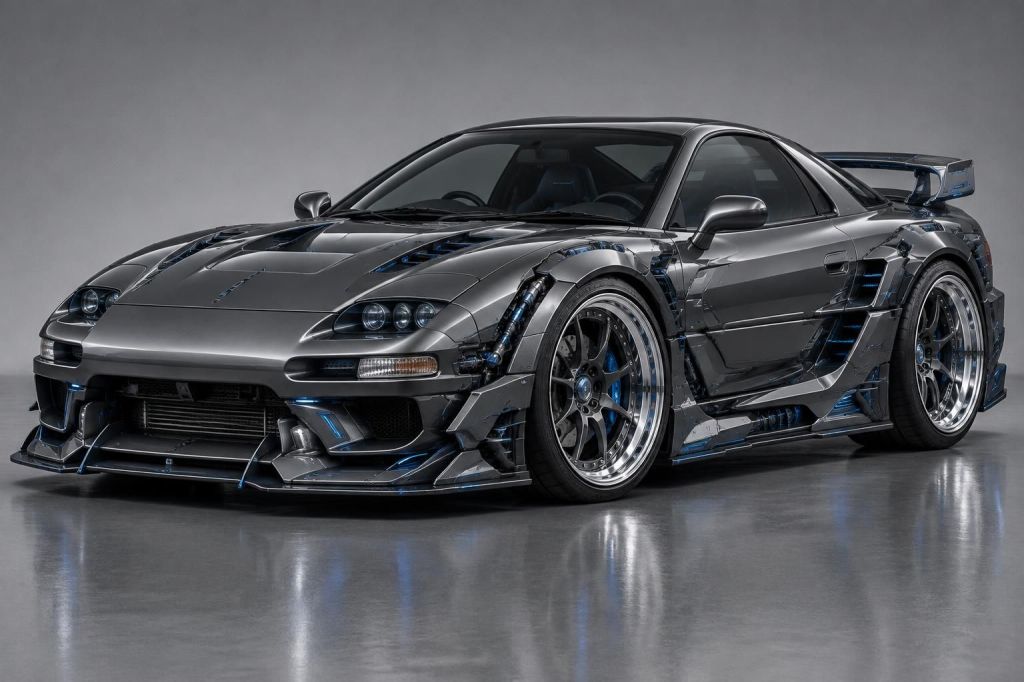
When the Mitsubishi GTO arrived in Japan, it brought a distinctly ambitious idea of the sports car: pair a sleek, low-slung coupe with a powerful V6, four-wheel drive, and advanced electronic features. Sold in export markets as the 3000GT, the GTO was designed to be more than a straight-line bruiser—it was a comfortable grand tourer packed with technology.
For 1992, buyers could choose a naturally aspirated GTO or the range-topping GTO Twin Turbo. Both used Mitsubishi’s 3.0-liter V6, while the Twin Turbo added forced induction and all-wheel drive. The model’s long hood, pop-up headlights, broad stance, and sculpted body gave it a futuristic presence that still feels unmistakably early ’90s.
The Twin Turbo’s headline features could include four-wheel steering, electronically controlled suspension, and active aerodynamic elements. These systems helped the GTO stand apart from more conventional coupes of the period, though equipment varied by trim and market. In the United States, the related 3000GT VR-4 had its own market-specific specifications, so figures shouldn’t be mixed with those of the Japanese GTO.
1992 Mitsubishi GTO spec sheet
The GTO came in multiple configurations, so the figures below describe the Japanese-market model and distinguish the naturally aspirated version from the Twin Turbo where possible.
| Specification | 1992 Mitsubishi GTO |
|---|---|
| Body style | Two-door liftback coupe |
| Engine | 2,972 cc 6G72 DOHC 24-valve V6 |
| Naturally aspirated output | 225 PS |
| Twin Turbo output | 280 PS |
| Twin Turbo torque | 42.5 kgf·m |
| Twin Turbo transmission | 5-speed manual |
| Drivetrain | Full-time four-wheel drive |
| Length | 4,600 mm |
| Width | 1,840 mm |
| Height | 1,285 mm |
| Wheelbase | 2,470 mm |
The Japanese Twin Turbo was rated at 280 PS; export-market ratings used different units and figures. The naturally aspirated Japanese GTO was offered with a five-speed manual or four-speed automatic, while the Twin Turbo launch model used a five-speed manual.
A coupe built around technology
The GTO’s appeal wasn’t just its engine. Mitsubishi brought together performance and touring comfort in a package that could be equipped with sophisticated driver-facing technology. On Twin Turbo models, available systems included active aero, four-wheel steering, and electronically controlled suspension. They gave the car a more complex personality than a simple rear-drive sports coupe: it was heavy and feature-rich, but purposeful as a fast, all-weather grand tourer.
The styling made its own statement. Pop-up headlights and a long, rounded nose set the tone, while the broad rear haunches and hatchback profile gave the car a muscular, almost exotic look. Today, that shape is an ideal canvas for a custom build—whether the goal is period-correct, understated, or, like the cyborg-inspired concept, full-on futuristic.
Why the 1992 GTO still stands out
The 1992 GTO captures a moment when Japanese performance cars were competing to offer not only speed, but innovation. Its combination of a V6, available twin turbos, four-wheel drive, and advanced chassis features made it a distinctive alternative to more familiar rivals. As a classic, it rewards enthusiasts who appreciate both its ambitious engineering and its unmistakable ’90s design.
Now for the poster!:

Leave a Reply